Rooflines: Pitch and Profile
The roofline is the defining geometric stroke of a home’s silhouette against the sky. In modern architecture, the roof serves a dual purpose: asserting aesthetic intent while executing rigorous environmental management.
The Flat Roof Aesthetic
The quintessential feature of Mid-Century Modern and contemporary architecture is the low-slope or flat roof. Visually, it reinforces a horizontal datum, keeping the mass of the house low and unobtrusive. Structurally, flat roofs (which always feature a slight, imperceptible pitch for drainage) utilize advanced single-ply membranes like EPDM or TPO. These reflective surfaces minimize the urban heat island effect and provide an ideal, concealed platform for photovoltaic solar arrays and HVAC equipment.
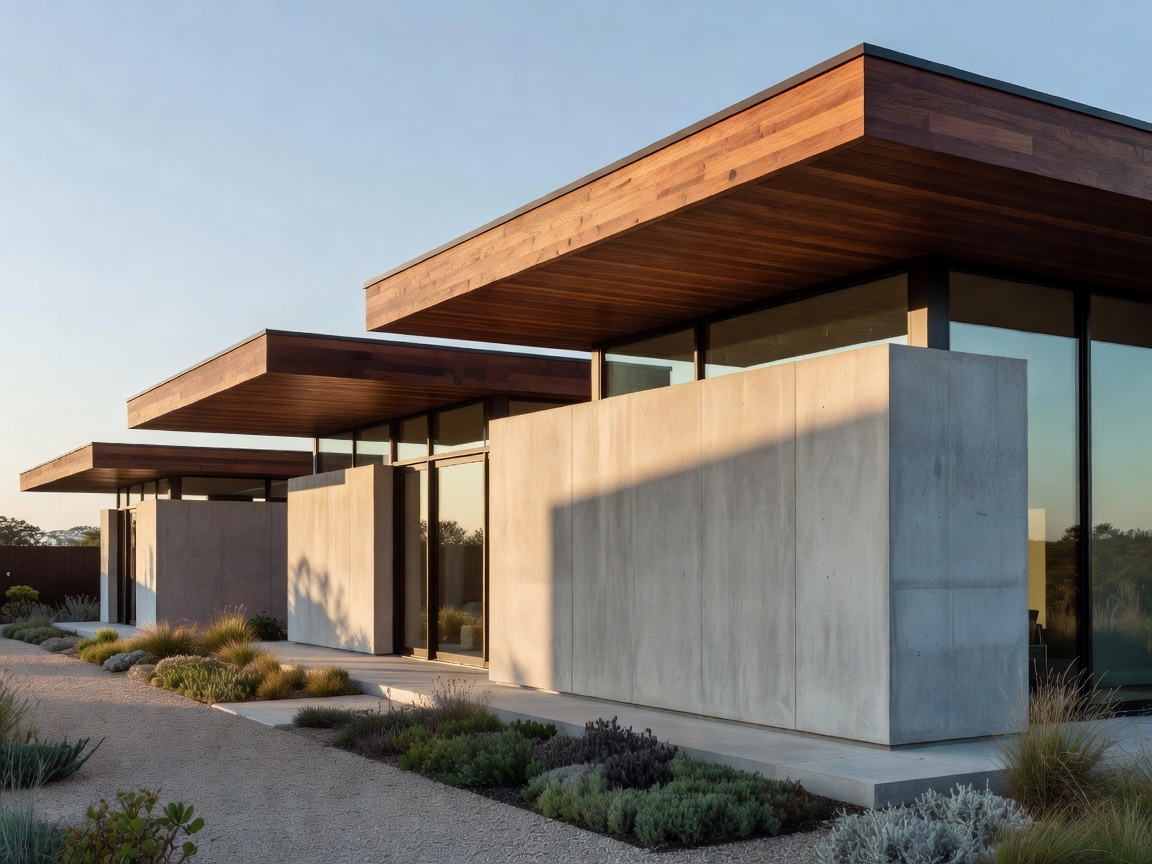
Overhangs and Eaves
Passive Solar Design
A deep, carefully calculated roof overhang is a functional necessity in modern design. By mapping the sun's trajectory, architects design eaves that project far enough to entirely shade the home’s glazing during the peak heat of summer (when the sun is high). Conversely, during winter when the sun's angle is low, the overhang allows direct sunlight to penetrate the home, hitting thermal mass floors (like concrete) to naturally heat the interior.
Mono-Pitch and Butterfly Roofs
Beyond flat profiles, modern homes frequently employ mono-pitch (shed) roofs to create soaring vaulted ceilings on the interior, directing rainwater to a single collection point for harvesting. Butterfly roofs (inverted gables) capture water in a central valley, offering a dramatic, aerodynamic aesthetic while enabling high clerestory windows that flood the core of the home with natural, diffused daylight.